GrantMaid vs Good Grants
GrantMaid vs Good Grants: 2026 comparison
Good Grants is a strong fit for teams that need broader reporting, advanced review modes, multilingual programs, or integrations. GrantMaid is a strong fit for lean US grantmakers that want seven fixed cross-program reports, custom reports within one program, one $200/month plan, unlimited seats and submissions, and setup without IT.
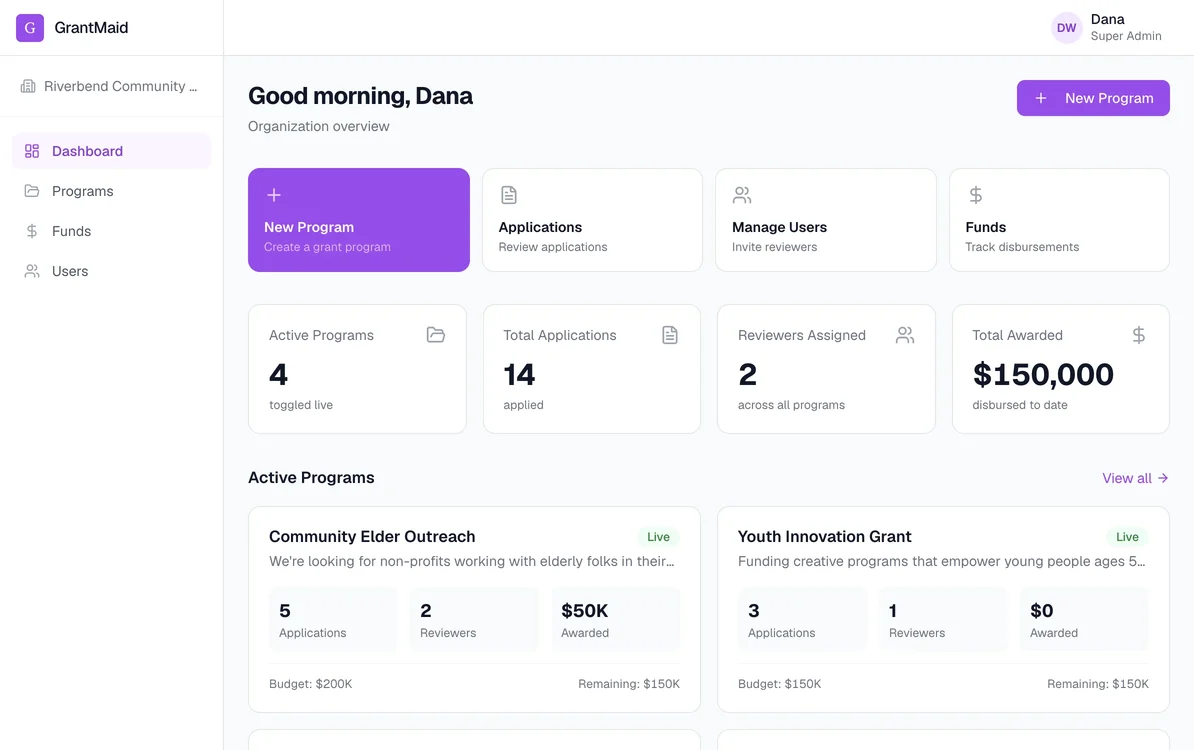
GrantMaid vs Good Grants
The short answer
Good Grants is a strong fit for teams that need broader reporting, advanced review modes, multilingual programs, or integrations. GrantMaid is a strong fit for lean US grantmakers that want seven fixed cross-program reports, custom reports within one program, one $200/month plan, unlimited seats and submissions, and setup without IT.
Good Grants publishes broader form, review, reporting, language, and integration options. GrantMaid has a smaller operating surface, exact US pricing, unlimited submissions, seven fixed reports across programs, and a custom report builder scoped to one program at a time.
See GrantMaid in actionGrantMaid
Best for lean US grantmakers that need core workflow, fixed cross-program reports, and custom reports within one program.
$1,800/year
Good Grants Intro
Best for teams that need reporting, more question types, unlimited decision stages, and broader applicant and reviewer tooling.
$3,950 USD/year
Good Grants Premium
Adds multiple active languages, workflow automation, integration marketplace/API, and additional review modes.
$7,900 USD/year
GrantMaid vs Good Grants at a glance
Good Grants pricing and capabilities were verified on its first-party pricing, integration, and onboarding pages on 29 August 2026. Confirm current terms before purchasing.
| Criterion | GrantMaid | Good Grants |
|---|---|---|
| Best fit | Lean US teams running straightforward grant programs. | Grantmakers needing advanced forms, review modes, reporting, multilingual programs, or integrations. |
| Published annual price | $1,800/year or $200 month-to-month. | Intro $3,950 USD/year; Premium $7,900 USD/year; Enterprise custom quote. |
| Users and submissions | Unlimited user seats and unlimited submissions. | Intro and Premium list unlimited users and up to 10,000 applications. |
| Application forms | Fourteen field types; named forms; one-condition conditional fields; and reportability guidance. A question can stop being asked without losing earlier answers, which remain on applications and in exports. | Lists 21 question types, conditional fields, auto-scoring, categories, and broader applicant controls. |
| Review workflow | Up to 10 active rounds, all renameable, reorderable and archivable, each with its own review form. Blind review withholds applicant names and answers marked as identifying. Rubrics use point weights and score anchors; weights can be withheld from reviewers. Admins see scores, recommendations and disagreement per round. Applications move manually; assignments can be bulk or workload-balanced. | Lists unlimited decision stages, several review modes, reviewer recusal, score matrices, and progress views. |
| Reporting and export | Cross-program reports are Application volume (submissions per month), Pipeline by round (where applications currently sit), Awards by program (net of adjustments), Awards over time (net awarded per month), Budget utilization (awarded against total budget, with over-budget shown in red), Decision funnel (the review pipeline, not counts of Successful, Unsuccessful or Withdrawn decisions), and Reviewer activity (assignments and completions). Within one program, admins can build and save custom reports based on its application questions. Saved reports are shared with everyone who can manage that program; only the creator or a super admin can change or delete them. The custom builder does not span multiple programs. Review scores remain separate by round and are not compared across rounds or programs. Application CSVs include the short Reference, Decision and Announced date columns alongside answers to every form question. Review exports contain one row per review and one column for every review-form question. | Lists reports, spreadsheet exports, PDF downloads, bulk downloads, and dashboards. |
| Integrations and identity | No integrations, API, SSO, or custom roles. | Premium lists integration marketplace/API; SAML SSO is listed as a paid add-on. |
| Implementation profile | A working program with custom forms can be configured in an afternoon without IT. | Good Grants provides a setup guide and checklist, offers paid onboarding with any plan, and includes implementation consulting with new Enterprise accounts; extra Enterprise implementation packages are paid add-ons. |
The honest tradeoff
Good Grants is the stronger fit when cross-program custom reporting, advanced review modes, multilingual programs, or integrations are required. GrantMaid’s custom report builder works within one program, while seven fixed reports span programs. GrantMaid’s case is a lower published US price, unlimited submissions, and a deliberately focused workflow for lean teams.
When to choose each platform
GrantMaid is a strong fit when
- Choose GrantMaid when $1,800 annual pricing, unlimited submissions, and setup without IT matter most.
- Choose GrantMaid when the team needs applications, up to 10 active rounds with their own review forms, blind review, weighted rubrics, award tracking and budget visibility.
Consider a broader system when
- Choose Good Grants when cross-program custom reporting, advanced review modes, multilingual programs, or integrations are required.
- Choose Good Grants when its broader form, review, reporting, language, and integration options justify the higher published plan price for your team.
Questions teams ask before they switch
Is GrantMaid better than Good Grants?
Neither product is universally better. GrantMaid fits lean teams prioritizing lower published US pricing, unlimited submissions, seven fixed cross-program reports, and custom reports within one program; Good Grants fits teams requiring broader reporting, advanced review modes, multilingual programs, or integrations.
What is the difference between GrantMaid and Good Grants?
GrantMaid combines a focused application-to-award workflow with seven fixed cross-program reports and a custom report builder inside each program. Good Grants is a broader platform with more question types, review modes, reporting, languages, and integration options.
Which product is cheaper?
GrantMaid publishes a $1,800 annual price. Good Grants lists Intro at $3,950 USD per year and Premium at $7,900 USD per year, verified 29 August 2026.
Can GrantMaid replace Good Grants?
GrantMaid can fit teams that need separate round forms, blind review, weighted rubrics with anchors and held decisions, but do not require cross-program custom reporting, integrations, multilingual operation or other review modes beyond GrantMaid’s verified scope.
Who should choose Good Grants instead?
Teams requiring cross-program custom reporting, advanced reviews, multilingual programs, SSO, or integrations should choose Good Grants instead of GrantMaid.
Can we review applications anonymously?
Yes. Blind review is configured per round, so you can screen anonymously and review finalists openly. Reviewers see a short reference instead of the applicant’s name. Answers to questions the funder marks as identifying are withheld too; the funder must choose those questions.
Can we weight criteria and define what each score means?
Yes. Each round’s review form can use criterion weights in points, which do not need to total 100, and anchors that describe what each score means. You can withhold the weighting from reviewers or collect a rating without including it in the score. Standard criteria use 1–5; a nominated score question can use your own scale. Scores stay within their own round; they are not compared across rounds or programs.
When do applicants see the decision?
You decide when applicants are told. Record Successful, Unsuccessful or Withdrawn with your own words, then hold decisions until you are ready to release them together. Held decisions remain editable. Announcing updates the applicant’s dashboard; no decision email is sent. Applicants see neither review rounds, scores, reviewer feedback nor award amounts. An announced decision is final and cannot be changed, unannounced or deleted. Withdrawn is a funder-recorded outcome, not applicant self-service. Award terms or next steps can be sent separately using manually composed bulk email to selected applicants.
Verified 12 September 2026; GrantMaid features updated 4 October 2026
A clearer way to run grants
See it for yourself in 30 minutes.
We’ll walk through the full platform—from form builder to reviewer workflow and award tracking. No pressure, no sales script.
Book a demo